REVIEW · AUSTIN
Double Decker Austin Single Loop Sightseeing Tour
Book on Viator →Operated by Double Decker Austin Tours · Bookable on Viator
Austin runs on stories. This double-decker loop gives you the fast, photo-friendly highlights with live guide commentary from the top or comfort from the bottom. I really love the two-deck setup (open-air up top, climate-controlled downstairs) and the way the route helps you get your bearings in a short amount of time.
One thing to keep in mind: the tour is designed for an overview, so you will not see everything up close, and you may need to duck a few times on the upper deck when trees crowd the route.
In This Review
- Key Points at a Glance
- Austin Visitor Center Start: Your Easy Launch Point on 5th Street
- Upstairs vs Downstairs: Choose Your Austin Viewing Style
- The Downtown Loop: 6th Street, the Driskill, and Texas Capitol Views
- Fire Museum to the Hannig House: Short Stops With Big Story Links
- Governor’s Mansion and the LBJ Connection: Power, Preservation, and Politics
- UT Austin and Stadium Icons: Why the Route Includes a Campus Turn
- Congress Avenue Bats and South Congress: The Part You’ll Want to Re-Visit
- Price and Time Value: What You’re Really Buying at $36.81
- Quick Tips So Your Ride Feels Smooth
- Should You Book the Double Decker Austin Single Loop Tour?
- FAQ
- How long is the Double Decker Austin single loop sightseeing tour?
- Where does the tour start?
- Is there live commentary, and what language is it in?
- Can I choose between an open-air and enclosed seat?
- How much does it cost?
- Do I need to print a ticket?
- Is there free cancellation?
- FAQ
- What is the main route focus of this sightseeing loop?
- When is the best time to see the bats at Congress Avenue Bridge?
- Is the tour limited in group size?
Key Points at a Glance

- Two-deck comfort: open-air photos up top, climate-controlled seating below
- Live guide commentary: you learn as you ride instead of fumbling with maps
- Big downtown hits in one loop: 6th Street, Driskill, Texas State Capitol, Governor’s Mansion
- UT Austin and Texas icons: Tower, major stadium, and museum stopovers from the road
- Seasonal wow moment: Congress Avenue Bridge bats are best April–October
- Small-group feel: capped at 35 travelers, so it stays easy to manage
Austin Visitor Center Start: Your Easy Launch Point on 5th Street

Your ride begins at the Austin Visitor Center, located at 103 E 5th St., between 4th and 5th streets (and the tour ends back there). This is a smart starting point because it’s central enough that you can connect it to the rest of your day—grab coffee before, then pick your next stop afterward.
If you’re the type who likes to understand a city before wandering off, this start helps. You’re not waiting at a random roadside pull-off. You’re starting in a place built for visitors, with the general vibe of Austin’s “show me what matters” mindset.
You can also read our reviews of more tours and experiences in Austin.



Upstairs vs Downstairs: Choose Your Austin Viewing Style
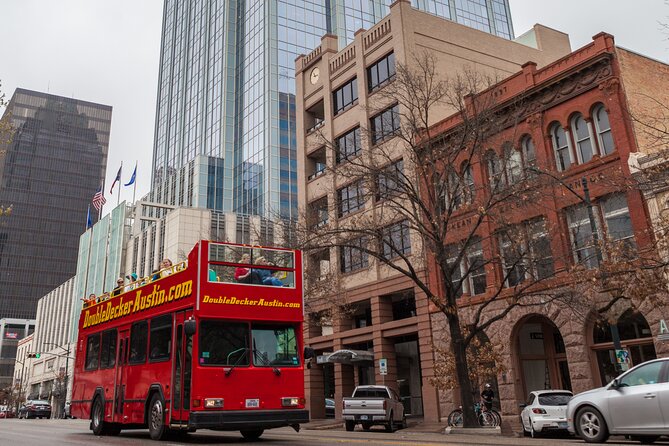
This is where the tour earns its keep. From the open-air top deck, you get better sightlines for photos and skyline views. You also get real-weather Austin—breeze, sun, and the occasional glare. From the climate-controlled lower deck, you stay comfortable if it’s hot, bright, or if you just want to stop thinking about wind direction for a while.
A practical note from the kind of real-world riding you’ll do: on the upper deck, expect to watch your head near tree limbs. Low branches are a thing on this route, so keep your posture flexible and your phone strap short.
The Downtown Loop: 6th Street, the Driskill, and Texas Capitol Views
The heart of the experience is the downtown sweep. You’ll pass 6th Street Entertainment District, where Austin’s energy is loudest and most obvious. From the bus, you can see the street’s layout and understand why it’s such a magnet for nightlife, live music, and people-watching.
Then comes the Driskill Hotel area. The Driskill is a Romanesque-style landmark completed in 1886 and known as the oldest operating hotel in Austin. Even if you don’t go inside, you’ll recognize why it’s on every “classic Austin” list—the building reads as big-league historic Texas the moment you roll past it.
Next is the Texas State Capitol, one of the nation’s most distinguished state capitols, recognized on historic registers and designated a National Historic Landmark. Seeing it from the road matters: you get immediate context for where it sits, how the grounds connect to nearby streets, and how the city organizes itself around it.
Fire Museum to the Hannig House: Short Stops With Big Story Links
This loop doesn’t just throw buildings at you. It strings Austin’s history together with quick context as you pass different sites.
One of the stops features Central Fire Station No. 1 and the Austin Fire Museum, with uniforms, photos, and memorabilia spanning the 19th to 21st centuries. It’s a reminder that Austin’s growth wasn’t just about politics and museums—it was also about the practical work of keeping a city running.
Another stop spotlights the Hannig home, built in 1869 by Joseph Hannig for his wife Susanna. The story connected to Susanna Dickinson is dramatic and very Texas: she survived the Battle of the Alamo and carried news of its fall to Sam Houston, which fed directly into the Republic of Texas victory at San Jacinto.
There’s also a stop that turns the spotlight on William Sydney Porter—better known as O. Henry—so you can connect the name to Austin and understand why his legacy belongs on a city overview like this.
Governor’s Mansion and the LBJ Connection: Power, Preservation, and Politics
After the Capitol, you move into the Texas government story that feels very immediate once you see the landmarks close together.
You’ll pass the Governor’s Mansion, serving as the official residence of Texas governors and families since 1856. It’s also noted as the fourth oldest continuously occupied governor’s residence in the U.S., and the oldest governor’s residence west of the Mississippi River. The tour also mentions the 2008 arson damage and the restoration effort—one of those facts that adds weight to the building beyond architecture.
From there, the loop includes an Austin stop tied to the Lyndon Baines Johnson Library and Museum, with reference to its dedication in 1971 and the idea that the library tells the facts, including the hard parts of history. Whether you’re a political-history person or not, that mention helps you understand why the LBJ site is treated like a must-see in Texas.





UT Austin and Stadium Icons: Why the Route Includes a Campus Turn
A surprising win of this tour is that it doesn’t stop at downtown. It presses into the University of Texas at Austin orbit so you can connect the city’s identity to its campus.
You’ll pass Darrell K Royal–Texas Memorial Stadium, home to the Longhorns since 1924. The tour framing here is useful: it gives you a quick sense of the stadium’s scale and why sports are woven into Austin culture.
Then there’s the UT Austin Tower, completed in 1937 and described as a distinguishing landmark and a symbol of academic excellence and opportunity. From the bus, the tower is easier to “read” than if you’re trying to spot it while walking through traffic.
You also pass major museum and research spots around UT, including the Bullock Texas State History Museum, the Blanton Museum of Art, and the Ransom Center. Even if you don’t step inside, seeing their presence as part of the campus landscape helps you plan follow-up visits later.
If you get a guide like Jason or Will (names you’ll see in past departures), you’ll likely hear extra humor and local color. If you get someone who speaks faster, you can still catch the main points by focusing on the big landmarks first—then let the stories fill in the blanks.
Congress Avenue Bats and South Congress: The Part You’ll Want to Re-Visit
This is where the bus loop transitions from “architecture and institutions” to “Austin weirdness,” in the best way.
You’ll pass the Congress Avenue Bridge, which shelters the largest urban bat colony in North America. The tour notes that between 750,000 and 1.5 million bats fly out near dusk, with best viewing months April through October. If bats are a bucket-list item for you, plan your best chance for an evening outing after the tour.
Then the route hits South Congress, a neighborhood south of Lady Bird Lake known for boutiques, eateries, galleries, and music venues. The practical value here is orientation. The bus shows you where South Congress sits so you can walk a section you like later without guessing.
You’ll also pass The Long Center, a performance and cultural venue. Even a quick visual pass helps you connect it to Austin’s live-music and arts scene—especially if your next plan is dinner and a show.
Price and Time Value: What You’re Really Buying at $36.81

At $36.81 per person, this tour is priced like an efficient city orientation tool. You’re paying for three things: transportation, live narration, and the chance to cover a lot of landmark density without dealing with parking or a patchwork of rides.
The duration is about 1 hour 15 minutes to 1 hour 30 minutes, so it fits cleanly into a travel day. If you’re doing a short trip, this can save you hours of figuring out what’s worth seeing versus what’s just nearby.
The best value shows up when:
- It’s your first day in Austin and you want a map in your head fast.
- You’re balancing sightseeing with real plans like meals, live music, or day trips.
- The heat (or cold) makes walking less fun than sitting in the comfort of a bus.
If you already know Austin well and want detailed stops with long time at each location, you might feel like you’re moving too quickly. One drawback mentioned in past experiences is that the route is built to cover many icons in limited time—so the focus stays on what most people consider the must-dos.
Quick Tips So Your Ride Feels Smooth
A few small choices can make the experience better.
- Pick your deck based on weather. If it’s warm or sunny, the lower deck keeps you focused on the landmarks. If the weather’s great, the top deck gives you better photos.
- Bring something for head-level awareness on the top deck. Tree branches can force a ducking moment.
- Aim to take the tour early in your visit. It helps you decide what to circle back to—Capitol grounds, UT area museums, or South Congress.
- If you care about a specific theme (for example, civil rights landmarks), don’t rely on a single bus pass. Use the tour to find the right neighborhoods, then plan a targeted walk or museum visit.
Should You Book the Double Decker Austin Single Loop Tour?
I’d book this if you want a practical orientation to downtown Austin, plus UT-area icons, plus the famous Congress Avenue bat stop in one package. The two-deck option is a real advantage, and the route includes the landmarks most visitors actually use to plan the rest of their trip.
Skip it if you’re chasing a slow, deep, every-building-with-a-stop kind of day. This is a loop built for time efficiency. You’ll get context and great photo angles, but you’ll still want follow-up visits if you want maximum detail at a single location.
FAQ
How long is the Double Decker Austin single loop sightseeing tour?
It runs for about 1 hour 15 minutes to 1 hour 30 minutes.
Where does the tour start?
The tour starts at the Austin Visitor Center, 103 E 5th St., Austin, TX 78701, and returns to the same meeting point.
Is there live commentary, and what language is it in?
Yes. The tour includes live commentary and it’s offered in English.
Can I choose between an open-air and enclosed seat?
Yes. You can select seating on the open-air upper deck or the climate-controlled lower deck.
How much does it cost?
The price is $36.81 per person.
Do I need to print a ticket?
No. The tour uses a mobile ticket.
Is there free cancellation?
Yes. Free cancellation is available up to 24 hours in advance for a full refund.
FAQ
What is the main route focus of this sightseeing loop?
The loop focuses on downtown Austin landmarks and highlights, including places like 6th Street, the Driskill Hotel, the Texas State Capitol, and the Governor’s Mansion, plus additional Austin sights such as UT-area locations and Congress Avenue.
When is the best time to see the bats at Congress Avenue Bridge?
The tour info notes the best viewing dates are April through October, with bats flying out near dusk.
Is the tour limited in group size?
Yes. The tour has a maximum of 35 travelers.